Top Signs You Need Gate Repair Service – Don’t Ignore These
A gate that hesitates for half a second before it moves isn’t quirky. It’s telling you the operator is working at overcapacity, usually because a hardware drag issue is doubling the motor’s load and cutting years off its life. The signs that you need gate repair in Pearl District show up weeks before a gate quits entirely – catching them early is the difference between a small fix and a full motor replacement. If you’d rather not diagnose it yourself, call (833) 482-6184 and we’ll take a look.
What are the warning signs your gate needs repair?
The clearest signs a gate needs repair are a slow or jerky start, grinding or clicking noises, a remote that only works up close, and a gate that reverses on its own. Any one of these means the system is telling you something is wrong before it fails outright. Watching for them turns a surprise breakdown into a planned, cheaper repair.
Most gate failures we diagnose across Pearl District follow the same pattern: a small mechanical problem loads the operator, the operator strains, and the strain eventually damages the motor or the control board. The warning sign is the cheap part. The motor is the expensive part. Reading the sign correctly is what saves money.
Here’s what to look for, grouped by what’s failing:
- Mechanical: jerky movement, a gate that drags, hinge squeal that comes back quickly after greasing, a post that leans.
- Electrical: slow movement in cold or heat, reduced remote range, a gate that responds only sometimes.
- Safety systems: false reversals, a gate that stops mid-travel, sensors that trip on their own.
- Access control: a keypad that needs repeated presses, a remote that’s stopped pairing, an intercom with no response.
Surface rust and paint chips are cosmetic. Hinge fatigue, post lean and operator strain are structural and affect both safety and operation. That distinction matters, and it’s the first thing a dedicated gate technician sorts out.
Mechanical warning signs: what’s cosmetic and what’s structural
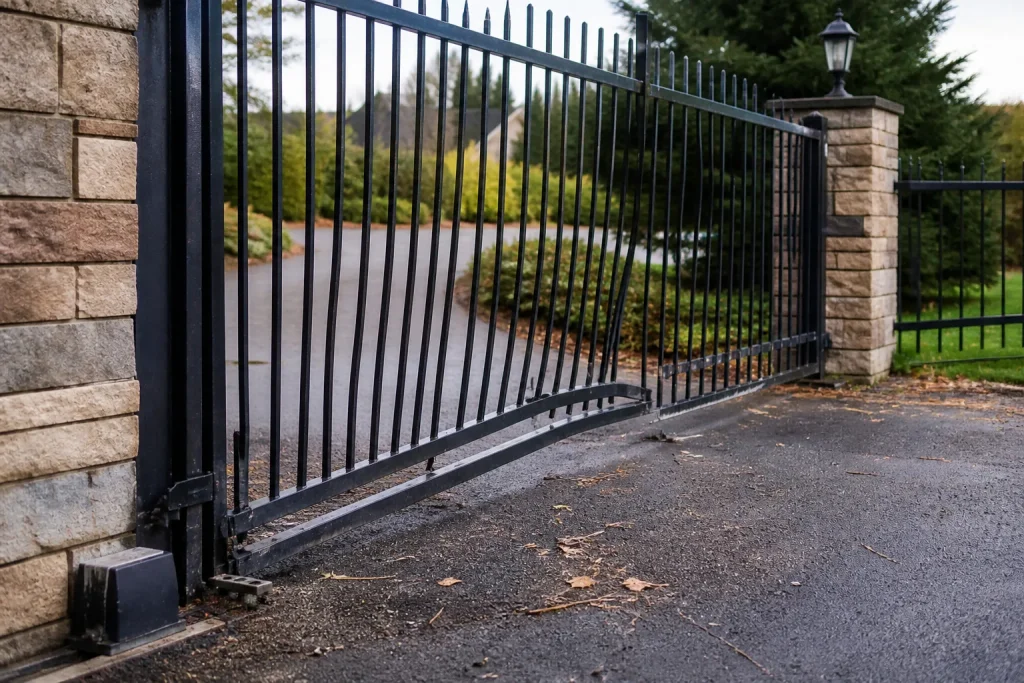
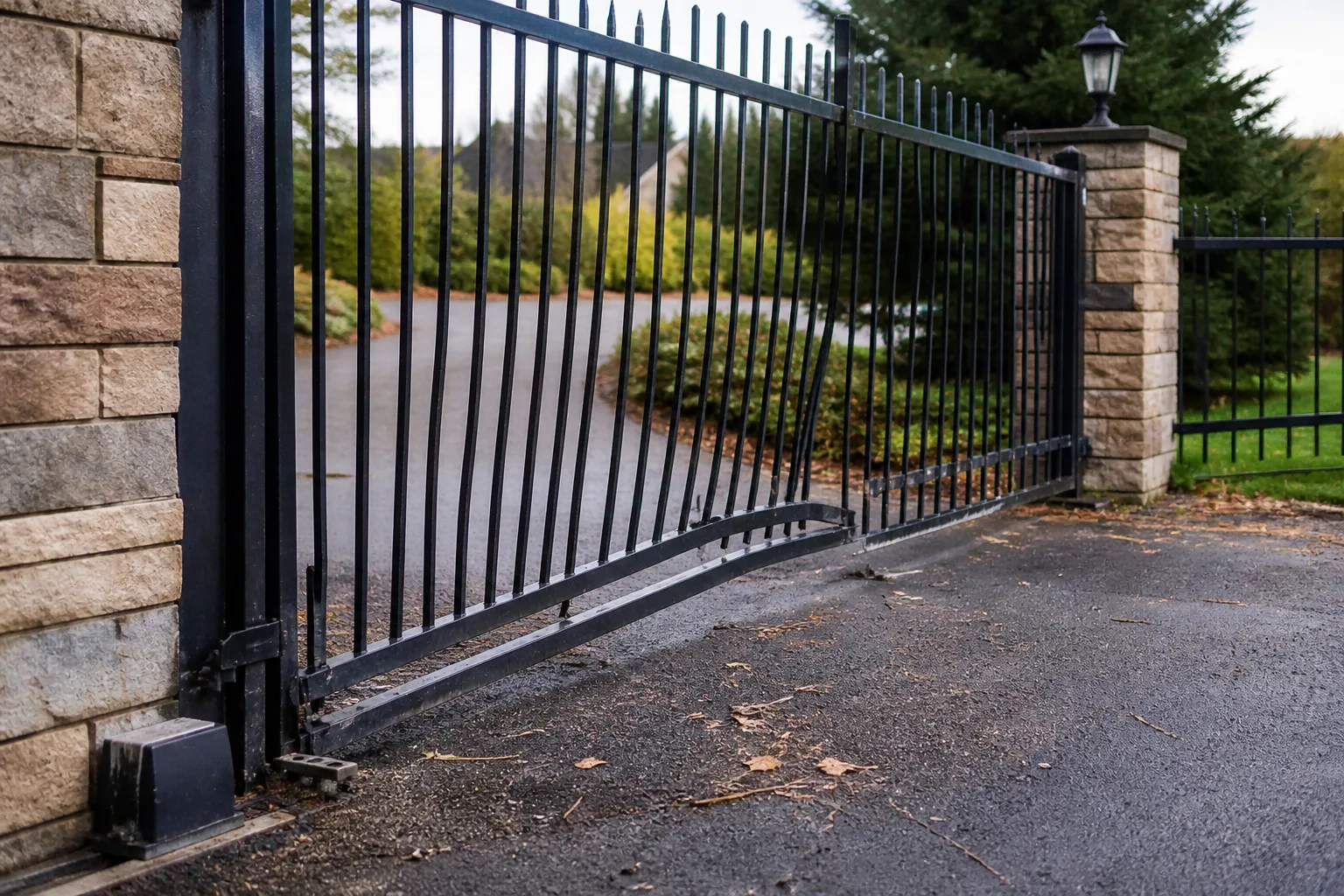
Cosmetic wear is surface rust, faded paint and chips on the panels. Structural warning signs are hinge fatigue, post lean, sagging gates and a track that’s out of line – the problems that change how the gate moves and how much load it puts on the operator. Structural issues are the ones that need repair, not a fresh coat of paint.
In our experience around Pearl District, hinge fatigue is the sign homeowners most often miss. A hinge that’s worn lets the gate drop slightly, and that tiny drop creates drag the motor has to fight on every cycle. Left alone, the drag stresses the operator until it fails. A post that’s leaning is worse: it throws the whole geometry off, and no amount of adjustment to the opener fixes a gate hanging crooked on a tired post.
Check for:
- Gate panels that sag or sit unevenly when closed
- Hinges with visible play, or a gate that swings loose
- Posts that lean or shift, especially after ground movement or heavy rain
- A slide gate that binds or comes off its track
- Squealing that returns within days of greasing – a sign the bearing or hinge is worn, not dry
If the gate itself is dragging or crooked, no motor will fix it. The hardware has to be sorted first, then the operator. That’s why we look at the whole gate before recommending a fix.
Electrical warning signs: what slow movement, weak remotes and hesitation actually mean
Electrical warning signs point to the operator and its wiring. Slow movement at temperature extremes, reduced remote range and inconsistent response are the big three – and each one tells a technician something specific. Slow movement in cold or heat usually means the motor is already near its limit and the extra load tips it over. Reduced remote range points to a receiver or antenna issue. Inconsistent response can be a failing control board, a weak battery in the remote, or a loose connection.
This is where electric gate repair gets more involved than most people expect. The wiring, the motor diagnostics and the safety-sensor alignment all interact, and a generalist who doesn’t work on gates daily will guess at it. We specialize in motorized gates for exactly that reason. Whether your system runs a FAAC or BFT operator or a Linear or Viking unit, the diagnostic path is similar: test the motor under load, check the wiring and connections, verify the sensors, then confirm the access control is behaving.
Signs that point to the electrical side:
- The gate runs noticeably slower in cold mornings or hot afternoons
- The remote only works when you’re close to the gate
- The gate moves, stops, then moves again on its own
- A keypad or intercom needs repeated tries
- The operator hums but the gate doesn’t move
If you’re seeing these, the operator is worth a proper diagnostic rather than a hopeful reset. Call (833) 482-6184 and we’ll trace it back to the source.
Why grinding and clicking sounds need immediate attention
Grinding or clicking during operation needs a diagnosis, not a squirt of lubricant. Those sounds usually mean a gear, bearing or drive component is wearing, and grease only masks the symptom while the wear gets worse. Catching it early is often the difference between replacing a wear part and replacing the whole operator.
Clicking typically points to a relay, a gear tooth or a limit switch. Grinding usually means metal is contacting metal inside the drive. In both cases, the operator is telling you a part is failing, and every cycle after that adds wear. The repair-first approach matters here: a brand-specific fix is often possible, and we won’t push a full replacement when the failure is a serviceable component.
Sounds to take seriously:
- Grinding that gets louder over a few days
- Clicking right before or after the gate moves
- Buzzing from the operator with no movement
- A crunch at the end of travel, suggesting a limit issue
None of these are fixed by lubrication as a first response. They need a technician to open the operator and see what’s actually worn.
Safety sensor signs that predict false reversals
Safety sensor problems show up as a gate that reverses on its own, stops mid-travel, or refuses to close. Those are false-reversal warning signs, and they usually appear before the gate stops working entirely. In Pearl District, morning condensation on the sensors is one of the most common triggers – moisture on the lens can make a sensor read an obstruction that isn’t there.
The sensors are a safety system, and a gate that’s reversing at random isn’t just annoying; it’s a sign the safety circuit is misreading its environment. Alignment, moisture, dirt and wiring all play a part. A technician checks the sensor alignment and the wiring, then confirms the gate closes cleanly with nothing in the path.
Signs your sensor system needs attention:
- The gate reverses with nothing in its path
- The gate stops partway and won’t continue
- The gate refuses to close until you hold the button
- The sensor indicator flickers on a damp morning
- The gate behaves differently after rain or heavy condensation
If any of these are happening, don’t prop the gate open and ignore it. The safety system is the part that keeps people and vehicles from being caught, and it’s worth getting checked. This is also a good moment for a technician to look at the access control side – a keypad, intercom or remote setup linked to the same system.
What each warning sign escalates to if you wait
Deferring a warning sign costs more than fixing it. A dragging hinge left for 30 days wears the operator; at 60 days the motor is straining; at 90 days the operator or control board often fails. The table below shows how the common signs typically escalate. Treat the timing as a general guide, not a guarantee – every gate runs differently.
| Warning sign | If deferred 30 days | If deferred 60 days | If deferred 90 days |
|---|---|---|---|
| Jerky or slow start | Hardware wear worsens | Operator strain builds | Motor or board failure likely |
| Grinding or clicking | Worn part worsens | Drive damage spreads | Full operator replacement |
| Reduced remote range | Receiver issue persists | Control faults appear | Access control repair grows |
| False reversal / sensor trips | Gate unusable at times | Safety system unreliable | Sensor and wiring repair |
| Sagging gate / leaning post | Drag increases | Operator overloaded | Post and hardware work |
None of these timelines are written in stone, but the pattern holds: the earlier sign is almost always the cheaper fix.
When to call a pro
If you’re seeing two or more of these signs at once, or any sign has lasted more than a week, it’s time to call. We diagnose and fix rather than replace unless replacement is genuinely the right call. From the motor to the access panel, we handle the whole system.
Related services in Pearl District: gate repair for the fix itself, gate motor & opener service when the operator is the problem, and gate installation if the gate is past repair. New to us? Start at Gate Repair Pearl District.
The Bottom Line
Most gate failures give clear warnings first. A jerky start, grinding, weak remotes and false reversals are all signs the system is telling you something needs attention. Catching them early is how you avoid the bigger bill. If you’re in Pearl District and need help, Gate Repair Pearl District offers free estimates – call (833) 482-6184. Our technicians have up to 9 years of experience and work on equipment from nine brands, including FAAC, BFT, Linear and Viking.
Frequently Asked Questions
The first sign is usually a slow or hesitant start. That hesitation means the operator is working harder than it should, often because of a drag issue in the hardware. Catch it early and it’s usually a small fix; ignore it and the motor takes the strain.
No. Grinding means a part is wearing or metal is contacting metal, and lubrication only hides the symptom. It needs a proper diagnosis so the worn part can be identified and fixed before it damages the operator.
False reversals usually come from the safety sensors. In Pearl District, morning condensation on the sensor lens is a common trigger. Misaligned or dirty sensors and wiring problems can also cause it. A technician checks the alignment and the wiring to confirm.
We recommend a check when you notice any warning sign, and a routine inspection for busy electric gates. Maintenance is priced per job after we look at the gate, and a single visit catches the small issues before they become expensive ones. Call (833) 482-6184 for a free estimate.
Written by the team at Gate Repair Pearl District.
Need Gate Repair Help?
Call Gate Repair Pearl District - the local pro we connect you with is licensed and insured, here with fast after-hours help in Pearl District.
(833) 482-6184